
Daraz vs Own Ecommerce Website: Which Makes More Money in Pakistan 2026?
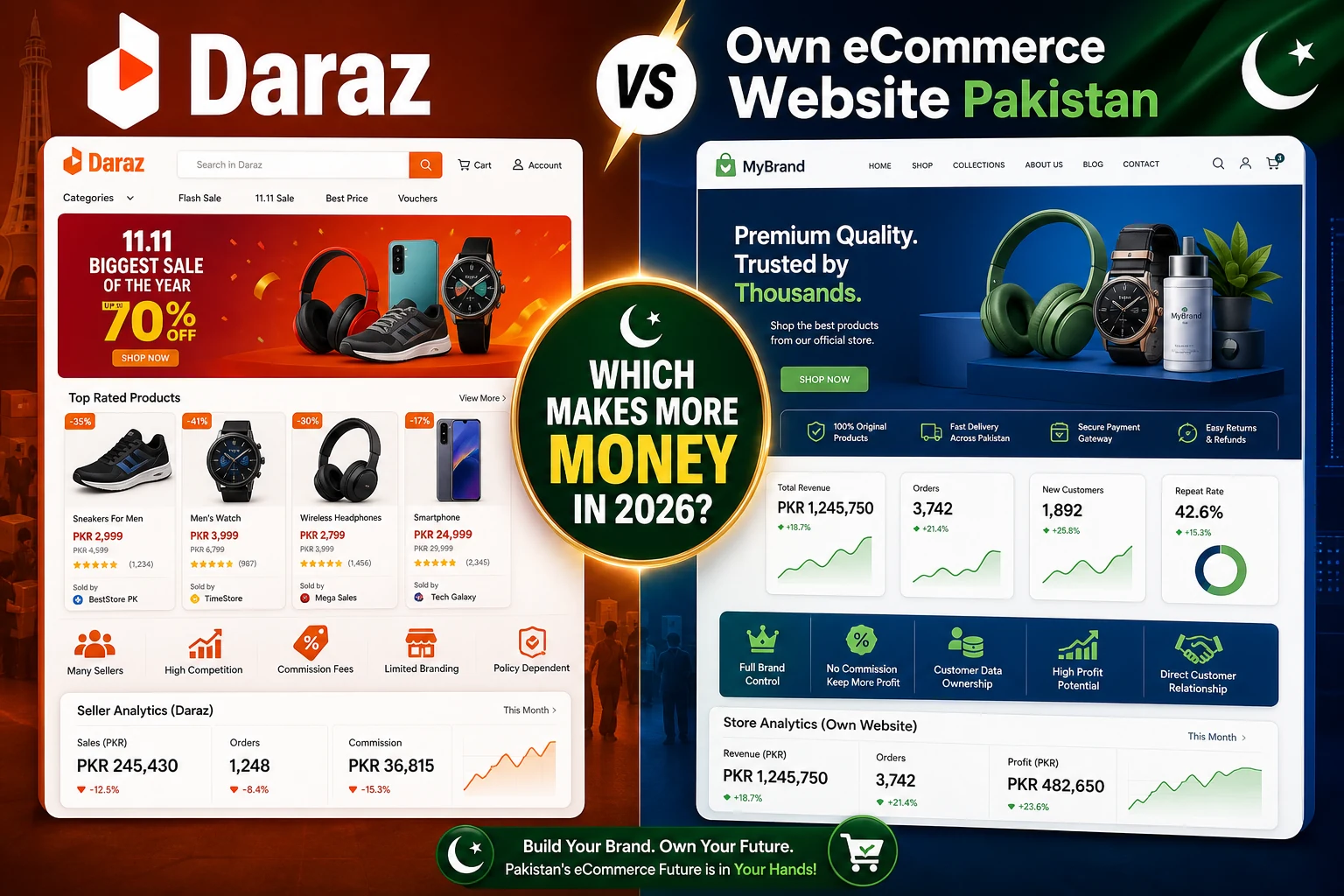
Table of Contents
Daraz vs Own Ecommerce Website: Which Actually Makes More Money in Pakistan? (2026 Honest Comparison)
Daraz vs own ecommerce website—this is the debate every Pakistani seller faces in 2026. You’re already selling (or planning to sell) online, and you’re wondering: should I keep paying Daraz 15-25% fees on every order, or should I invest in my own ecommerce website where I keep all the profit? Is the traffic Daraz gives you worth the commission they take? Can you actually get customers to your own website without Daraz’s massive audience?
This is an honest, no-hype comparison. I’ll show you the real numbers—what Daraz actually costs you per order, what an own website costs to build and run, and at what point your own website becomes significantly more profitable. I’ve helped dozens of Pakistani sellers transition from Daraz-only to their own stores, and the results are often surprising.
Whether you’re a Daraz seller making PKR 200,000/month frustrated with shrinking margins, or a new entrepreneur deciding where to start, this guide gives you the data to make a smart decision. For ecommerce development services, see my Custom Ecommerce Solutions page.
Advantages of Selling on Daraz
Let’s be fair—Daraz isn’t all bad. Here’s where Daraz wins in the Daraz vs own ecommerce website comparison:
- Built-in traffic — Millions of buyers already browsing. No marketing needed to start getting sales.
- Zero upfront investment — No website development cost. Start selling immediately.
- Trust factor — Customers trust Daraz brand. New buyers hesitate on unknown websites.
- Logistics support — Daraz handles shipping in many cases (Daraz Express).
- Payment collection — They handle COD risk, returns, and refunds.
- Campaign exposure — 11.11, 12.12, and mega sales bring massive traffic spikes.
- No technical knowledge required — Simple seller portal to manage listings.
Advantages of Your Own Ecommerce Website
Here’s where your own website wins in the Daraz vs own ecommerce website comparison:
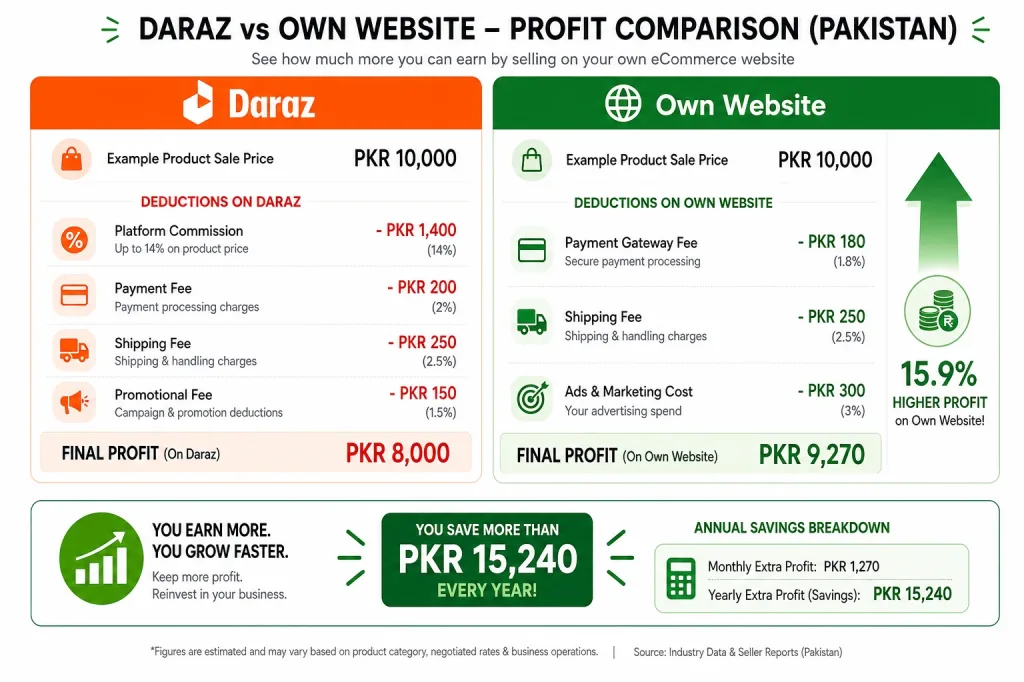
- Higher profit margins — Save 10-20% per order in marketplace fees (as shown above).
- Customer data ownership — You get email, phone, purchase history. On Daraz, the customer belongs to Daraz, not you.
- Brand building — Your own website builds YOUR brand. On Daraz, customers remember “I bought from Daraz” not your store name.
- No algorithm dependency — Daraz can change search ranking, suppress your listings, or boost competitors. Your website = your rules.
- Repeat customer marketing — Email/WhatsApp your customers directly for repeat orders. On Daraz, you can’t contact buyers.
- Pricing freedom — No price wars forced by marketplace algorithms showing “lowest price” prominently.
- Full design control — Custom shopping experience that matches your brand identity.
- Business valuation — An ecommerce website with traffic and customers has real sale value. A Daraz seller account has almost none.
- No account suspension risk — Daraz can suspend your account over minor issues. Your own website can never be “taken away.”
When to Choose Daraz (Honest Assessment)
In the Daraz vs own ecommerce website debate, Daraz makes sense when:
- You’re brand new to ecommerce and want to test if your products sell online
- You have zero budget for website development or marketing
- You sell generic/commodity products where brand doesn’t matter
- You want sales immediately without building an audience first
- You’re a small side business (under PKR 100,000/month revenue)
When to Build Your Own Ecommerce Website
Your own website makes financial sense when:
- You’re doing 50+ orders/month on Daraz — The fees you save will pay for website development within 3-6 months
- You have a branded product — If you’ve built a brand, you need your own home online
- You want to build long-term business value — Customer data + brand + traffic = sellable asset
- You’re tired of Daraz’s rules — Price matching, late payment disbursement, account suspension threats
- You want to run Facebook/Instagram ads — Sending paid traffic to your own website is more profitable than to Daraz
- You have repeat customers — Selling to them directly saves fees on every repeat order
- You sell premium/niche products — Your own website gives the premium experience these products deserve
The Smart Strategy: Use Both Daraz AND Your Own Website
The smartest sellers in Pakistan don’t choose between Daraz vs own ecommerce website—they use BOTH strategically:
The Dual-Channel Strategy
- Keep selling on Daraz for visibility and new customer acquisition
- Build your own website for higher-margin direct sales
- Include a branded card in every Daraz order: “Order directly from [yourwebsite.com] for 10% discount next time”
- Run Facebook ads to your own website (not Daraz) — you keep all the profit
- Email/WhatsApp previous customers with offers on your website
- List premium products exclusively on your website at higher margins
This way you get Daraz’s free traffic while gradually building your own customer base. Over 6-12 months, your own website revenue can surpass Daraz revenue—with better margins.
How to Get Traffic to Your Own Website (Without Daraz)
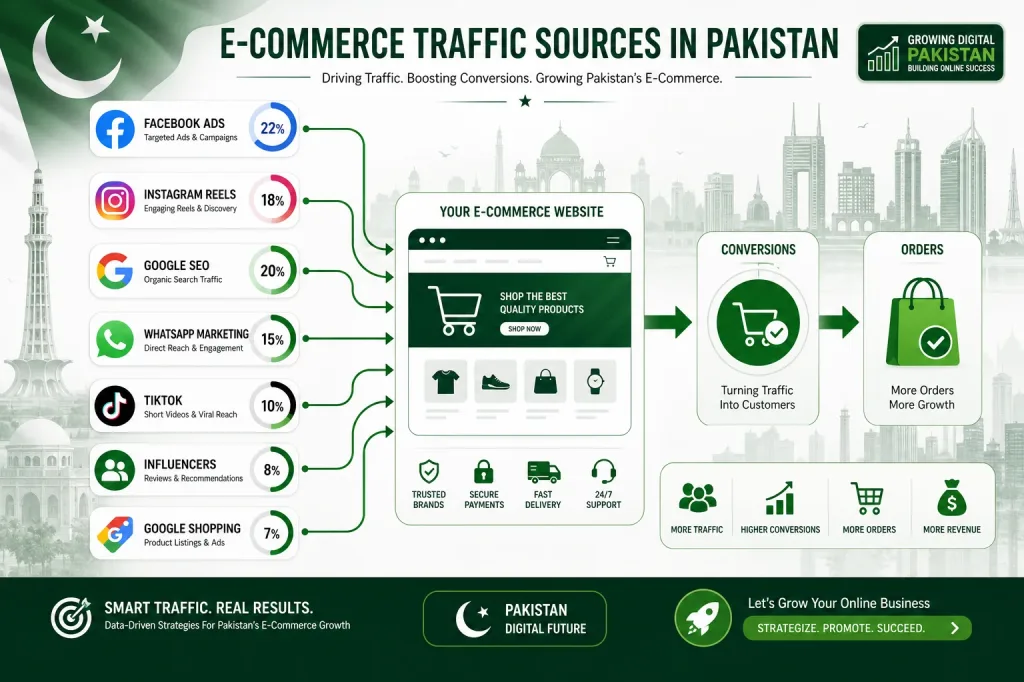
The #1 fear in the Daraz vs own ecommerce website debate: “How will customers find my website?” Here’s how Pakistani sellers get traffic:
1. Facebook & Instagram Ads (Primary Channel)
60-70% of Pakistani ecommerce traffic comes from Facebook/Instagram ads. Budget: PKR 500-2,000/day for testing. At PKR 30,000/month ad spend, expect 3,000-10,000 website visitors and 50-200 orders (depending on product and targeting).
2. WhatsApp Marketing
Build a WhatsApp broadcast list from your Daraz customers (via branded cards in orders). Send new arrivals, sales, and exclusive offers. Free traffic with high conversion rates.
3. Google SEO (Free Long-Term Traffic)
Optimize your product pages for search terms like “buy [product] online Pakistan.” Takes 3-6 months to see results, but once ranking, you get free traffic daily. Read about SEO in my Website Maintenance Services guide.
4. Instagram/TikTok Organic Content
Post product videos, customer reviews, behind-the-scenes content. Free traffic from reels/TikToks that go viral. Many Pakistani brands get 50%+ sales from organic social media.
5. Google Shopping Ads
Show your products in Google Shopping results when people search for them. Works especially well for branded and niche products.
6. Influencer Marketing
Partner with micro-influencers (10K-50K followers) for PKR 5,000-20,000 per post. Often generates immediate sales and social proof.
How Much Does Your Own Ecommerce Website Cost in Pakistan?
If you’re now leaning toward your own website in the Daraz vs own ecommerce website comparison, here’s what it costs:
| Option | Setup Cost | Monthly Cost | Best For |
|---|---|---|---|
| Shopify Store | PKR 50,000–150,000 | PKR 8,000–25,000 | Beginners, quick launch, simple catalog |
| WooCommerce Store | PKR 100,000–400,000 | PKR 5,000–15,000 | Growing businesses, large catalogs, full ownership |
| Custom Ecommerce | PKR 300,000–1,500,000 | PKR 10,000–30,000 | Established brands, unique features, scalability |
ROI Example: A PKR 150,000 Shopify store that saves you PKR 40,000/month in Daraz fees pays for itself in under 4 months. Everything after that is pure extra profit.
For detailed pricing breakdown, read my complete guide: Ecommerce Website Development Cost in Pakistan 2026.
Ready to Build Your Own Store? Here’s What to Do Next
If the numbers in this Daraz vs own ecommerce website comparison convince you, here’s your action plan:
- Keep selling on Daraz — Don’t stop. Maintain your existing revenue while building your website.
- Choose your platform — Shopify for simplicity, WooCommerce for flexibility, or custom for scale.
- Get your website built — Professionally, with JazzCash/EasyPaisa, COD, and mobile optimization.
- Start Facebook ads — PKR 1,000/day sending traffic to your website. Test and optimize.
- Include branded cards in all Daraz orders pointing to your website.
- Build your email/WhatsApp list — Every website customer becomes a direct-contact repeat buyer.
- Track both channels — Monitor revenue and profit from Daraz vs your website monthly.
Within 6 months, most sellers see their own website generating equal or higher revenue than Daraz—with significantly better profit margins.
Ready to Build Your Own Ecommerce Website?
Frequently Asked Questions
Is it better to sell on Daraz or build your own ecommerce website?
In the Daraz vs own ecommerce website debate: Daraz is better for absolute beginners with zero budget. Your own website is better for sellers doing 50+ orders/month who want higher profits, brand ownership, and customer data. The smartest strategy is using both simultaneously.
How much does Daraz charge sellers?
Daraz charges 5-15% commission (varies by category) + 1-2% payment fee + shipping fees. Total effective cost is 10-25% per order. On a PKR 5,000 product, you pay PKR 500-1,250 in fees. Your own website only has 2-3% payment gateway fees.
How much does an own ecommerce website cost in Pakistan?
Own ecommerce website costs: Shopify (PKR 50,000-150,000 setup), WooCommerce (PKR 100,000-400,000), or custom (PKR 300,000-1,500,000). The investment typically pays for itself within 3-6 months through saved marketplace fees. See detailed pricing in my Ecommerce Cost Guide.
Can I sell on both Daraz and my own website?
Yes! The dual-channel strategy is recommended. Use Daraz for visibility while building your own customer base through your website. Include branded cards in Daraz orders directing customers to your website for future purchases at better prices.
How do I get customers without Daraz?
Primary traffic sources: Facebook/Instagram ads (60-70% of Pakistani ecommerce traffic), WhatsApp marketing, Google SEO, TikTok/Instagram organic content, and influencer partnerships. Most sellers start with PKR 30,000/month Facebook ad budget and scale from there.
Do I need technical skills for my own website?
No. Shopify and WooCommerce have simple admin panels for managing products and orders—similar to Daraz’s seller portal. A professional developer handles the technical setup. You manage day-to-day operations like you already manage your Daraz account.
For platform comparisons, check Shopify’s platform guide and learn about WooCommerce features.