
Multi Vendor Marketplace Development Pakistan 2026 | Build Like Daraz
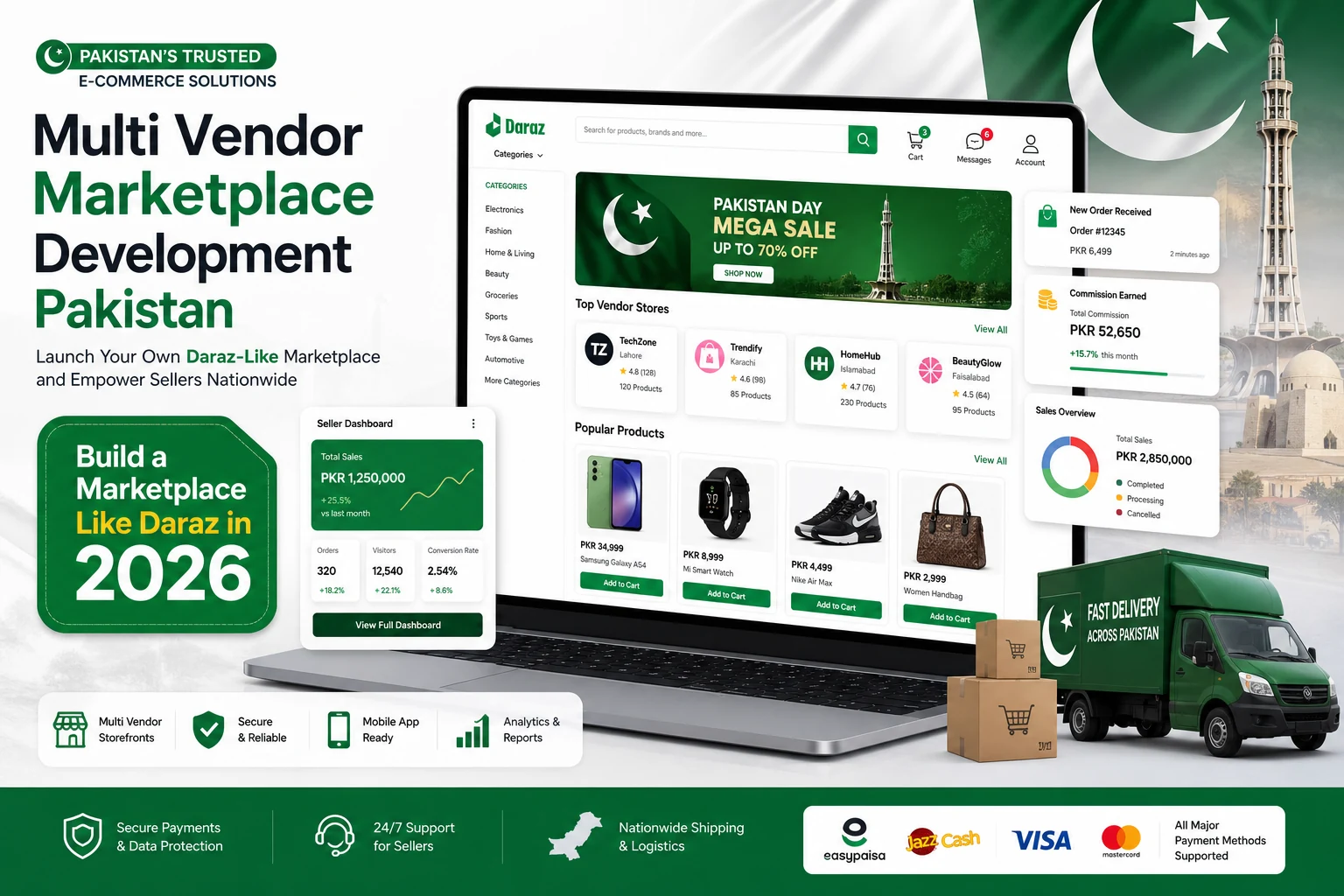
Table of Contents
Multi Vendor Marketplace Development Pakistan: How to Build a Marketplace Like Daraz in 2026 (Complete Guide)
Multi vendor marketplace development in Pakistan is one of the most searched topics by entrepreneurs who see the success of Daraz, Goto, and OLX and want to build their own online marketplace. Pakistan’s ecommerce market is projected to reach $20.41 billion by 2029, growing at 9.7% annually—and multi vendor marketplaces capture the largest share of this growth. If you’ve been thinking about building a marketplace where multiple sellers can list and sell products through your platform, this guide covers everything you need to know. But here’s what most articles won’t tell you: building a marketplace like Daraz requires very different thinking than building a regular ecommerce store. You’re not just building a website—you’re building a platform that serves TWO audiences (vendors AND customers), handles complex operations (split payments, multi-vendor shipping, commission tracking), and needs to scale from day one. Understanding these challenges before you invest is critical. As someone who has built multiple marketplace platforms for Pakistani businesses, I’ll walk you through the real features you need, actual costs in PKR, technology choices, timeline, and the mistakes that kill most marketplace startups before they gain traction. For my marketplace development services, visit the Multi-Vendor Marketplace Development service page.What is Multi Vendor Marketplace Development?
Multi vendor marketplace development is the process of building an online platform where multiple independent sellers (vendors) can register, list their products, and sell to customers—while you (the marketplace owner) manage the platform, handle payments, and earn commission on every sale. Think Daraz, Amazon, Etsy, or Fiverr—all are multi vendor marketplaces. Unlike a single-vendor ecommerce store where YOU sell products, a multi vendor marketplace lets hundreds or thousands of sellers use YOUR platform. You don’t hold inventory. You don’t ship products. You provide the technology, traffic, and trust—and take a percentage of every transaction.How a Marketplace Differs from an Ecommerce Store
| Feature | Single-Vendor Store | Multi Vendor Marketplace |
|---|---|---|
| Sellers | Only you | Multiple independent vendors |
| Inventory | You manage all stock | Each vendor manages their own |
| Revenue model | Product profit margins | Commission per sale (5-25%) |
| Shipping | You handle all shipping | Each vendor ships their orders |
| Investment | Buy inventory upfront | No inventory needed |
| Scalability | Limited by your inventory | Unlimited (more vendors = more products) |
| Development cost | PKR 100K-500K | PKR 400K-2,500K+ |
Why Build a Marketplace in Pakistan in 2026?
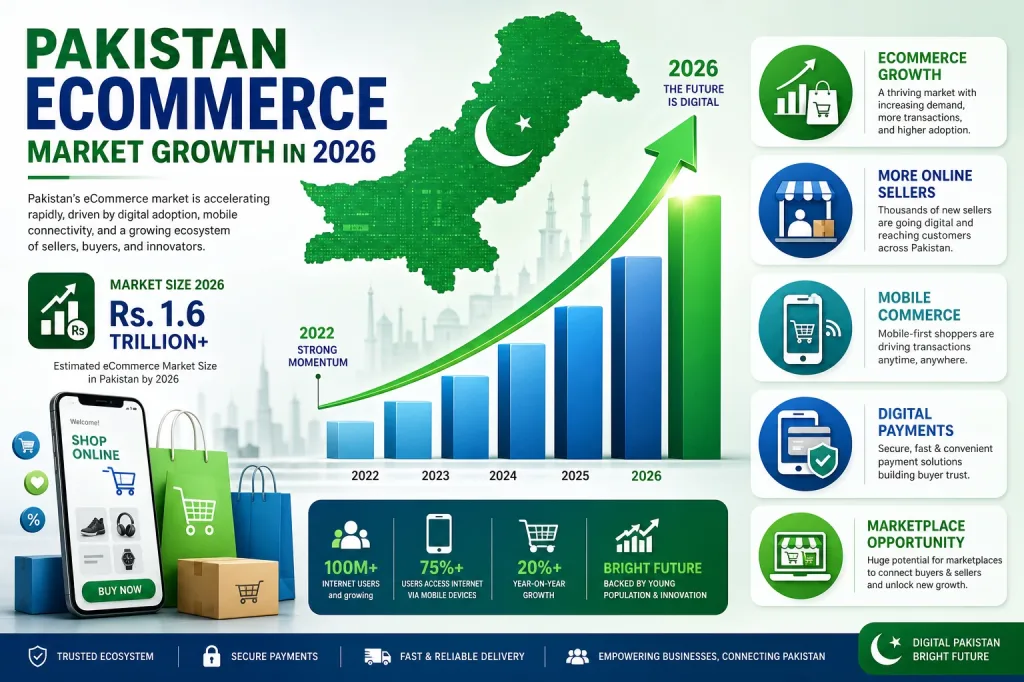
The timing for multi vendor marketplace development in Pakistan has never been better. Here’s why:- $20.41 billion market by 2029 — Pakistan’s B2C ecommerce is growing at 9.7% CAGR
- 117 million internet users — massive addressable audience
- 80 million social media users — ready-made customer acquisition channels
- Digital payment adoption exploding — JazzCash, EasyPaisa, Raast, and QR payments making online transactions mainstream
- Daraz can’t serve every niche — vertical/niche marketplaces have massive opportunity
- Seller frustration with existing platforms — high fees, poor support, and algorithm changes drive vendors to alternatives
The Opportunity Gap
While Daraz dominates general ecommerce, Pakistan has almost no quality niche marketplaces. In developed markets, niche marketplaces like Etsy (handmade), StockX (sneakers), Reverb (music gear), and Houzz (home decor) generate billions. Pakistan’s niche marketplace space is wide open—the first quality marketplace in any niche can dominate within 12-18 months.Essential Features for Multi Vendor Marketplace Development
Successful multi vendor marketplace development in Pakistan requires three sets of features: for vendors, for customers, and for administrators. Here’s what you need:Vendor Features (Seller Side)
- Vendor registration & approval — Signup form, document verification, admin approval workflow
- Vendor dashboard — Sales analytics, order management, earnings, and payout history
- Product management — Add/edit products, variants, images, pricing, inventory tracking
- Order management — View orders, update status, print shipping labels, handle returns
- Payout system — Automatic commission calculation, payout requests, payment history
- Vendor profile/store page — Custom vendor storefront with branding, ratings, and reviews
- Shipping management — Set shipping rates, zones, and delivery times per vendor
Customer Features (Buyer Side)
- Product browsing — Search, categories, filters, sorting by price/rating/relevance
- Multi-vendor cart — Add products from different vendors in single cart
- Unified checkout — Single checkout for products from multiple vendors
- Payment options — JazzCash, EasyPaisa, COD, bank transfer, credit/debit cards
- Order tracking — Track each vendor’s shipment separately
- Reviews & ratings — Rate products and vendors separately
- Wishlist & compare — Save favorites, compare similar products
Admin Features (Platform Owner)
- Admin dashboard — Total sales, revenue, commission earned, vendor/customer stats
- Vendor management — Approve/reject vendors, monitor performance, suspend violators
- Commission management — Set global or per-vendor/per-category commission rates
- Product moderation — Review and approve products before listing
- Payout management — Process vendor payouts, payment history, dispute resolution
- Reports & analytics — Sales reports, vendor performance, customer behavior
- Settings & configuration — Payment gateways, shipping, tax, email notifications
Pakistan-Specific Features
- Cash on Delivery (COD) — Essential for Pakistan; 40%+ customers prefer COD
- JazzCash & EasyPaisa — Mobile wallet payments for 80M+ users
- Courier integration — TCS, Leopards, BlueEx, PostEx for automated shipping
- FBR tax compliance — Invoice generation with proper tax calculations
- Urdu support — Optional but valuable for broader market reach
Multi Vendor Marketplace Development Cost in Pakistan 2026
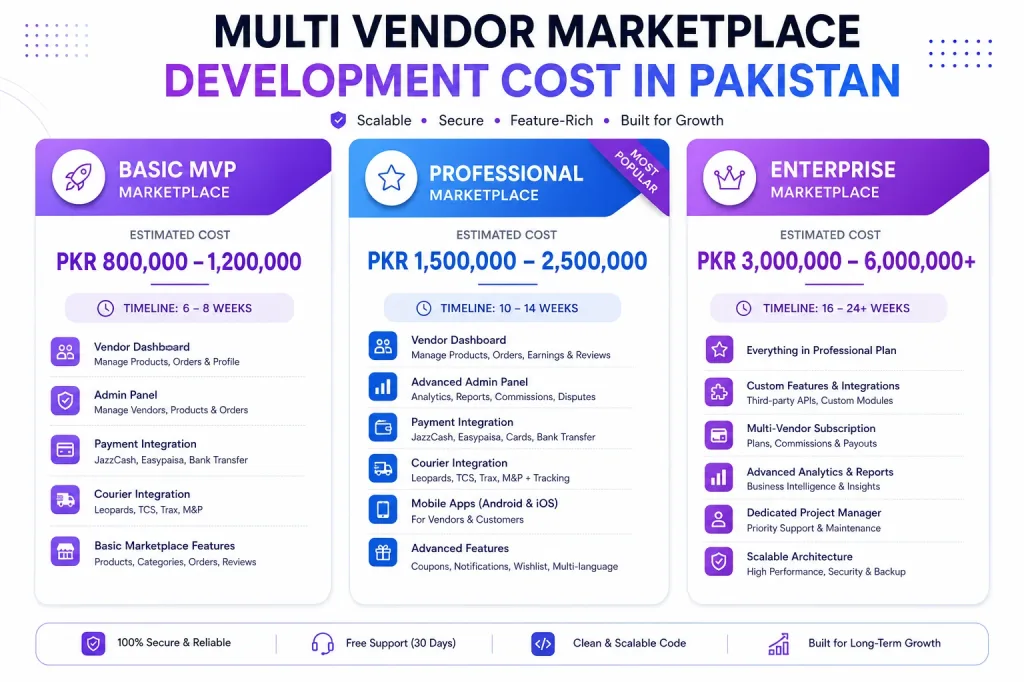
Here’s the real multi vendor marketplace development cost in Pakistan based on different approaches:| Marketplace Type | Cost (PKR) | Cost (USD) | Timeline | Best For |
|---|---|---|---|---|
| Basic MVP Marketplace (WooCommerce + Dokan) | PKR 400,000–800,000 | $1,450–$2,900 | 8–12 weeks | Testing your marketplace idea with 10-50 vendors |
| Professional Marketplace (Custom with advanced features) | PKR 800,000–1,500,000 | $2,900–$5,400 | 14–20 weeks | Serious marketplace with 50-200 vendors |
| Enterprise Marketplace (Full custom, mobile apps) | PKR 1,500,000–2,500,000+ | $5,400–$9,000+ | 20–30 weeks | Large-scale platform with 200+ vendors, mobile apps |
What Drives Marketplace Development Cost?
- Number of features — More vendor/admin features = higher cost
- Custom design vs template — Custom UI adds PKR 200,000-500,000
- Payment complexity — Split payments, escrow, multi-currency add cost
- Mobile apps — iOS + Android apps add PKR 500,000-1,500,000
- Integrations — Courier APIs, accounting software, SMS gateways
- Platform choice — WooCommerce is cheaper; custom Laravel/React costs more but scales better
Technology Stack: WooCommerce vs Custom vs SaaS
Choosing the right technology for multi vendor marketplace development in Pakistan is critical. Here are your options:
Option 1: WordPress + WooCommerce + Dokan/WCFM (Budget)
- Cost: PKR 400,000–800,000
- Pros: Fastest to launch, large plugin ecosystem, lower cost, familiar admin panel
- Cons: Performance issues at scale (100+ vendors), plugin dependency, limited customization, security concerns with too many plugins
- Best for: MVP/testing phase, small niche marketplaces with under 50 vendors
Option 2: Custom Development — Laravel + React/Vue (Professional)
- Cost: PKR 800,000–2,500,000+
- Pros: Unlimited scalability, full ownership, custom features, better performance, no plugin dependency
- Cons: Higher cost, longer development time, requires experienced developer
- Best for: Serious marketplace businesses planning to scale to 100+ vendors
Option 3: SaaS Platforms — Sharetribe, CS-Cart (Quick Launch)
- Cost: PKR 50,000–200,000 setup + $79-499/month subscription
- Pros: Fastest launch (days not months), no development needed, managed hosting
- Cons: Limited customization, ongoing monthly fees, no Pakistani payment gateway support, data ownership concerns
- Best for: Non-technical founders wanting to validate idea before investing in custom development
My Recommendation for Pakistani Marketplaces
Start with WooCommerce + Dokan if you’re testing your marketplace concept with limited budget. Once you validate the model and have 30+ active vendors, invest in custom development (Laravel + React) for proper scalability. This two-phase approach optimizes your multi vendor marketplace development investment and reduces risk.
Profitable Niche Marketplace Ideas for Pakistan 2026
Don’t compete with Daraz on general ecommerce. Build a niche marketplace that serves a specific market. These niches have proven demand and low competition in Pakistan:
High-Potential Niches
- Agricultural marketplace — Connect farmers directly to buyers (huge market, zero quality platforms)
- Handmade & artisan goods — Pakistan’s craft industry needs its own Etsy
- Auto parts marketplace — Massive demand, fragmented supply
- B2B industrial supplies — Manufacturers buying from wholesalers online
- Services marketplace — Local services (plumbers, electricians, tutors) like Thumbtack
- Rental marketplace — Equipment, vehicles, event supplies
- Food & grocery marketplace — Multi-vendor food delivery or wholesale grocery
- Fashion marketplace — Pakistani designers and boutiques selling on one platform
- Real estate marketplace — Property listings from multiple agents
- Wedding services marketplace — Venues, photographers, caterers in one place
The key to niche marketplace success: solve a specific problem that Daraz can’t. General marketplaces can’t provide the specialized features, curation, and trust that niche buyers need. Your multi vendor marketplace development should focus on one niche and dominate it.
How Marketplace Owners Make Money
Understanding revenue models is essential before investing in multi vendor marketplace development in Pakistan:
Primary Revenue Streams
- Commission per sale (5-25%) — Most common model. You take a percentage of every transaction. Daraz takes 5-15% depending on category.
- Vendor subscription fees — Monthly/annual fee for vendors to list on your platform. Works for premium/curated marketplaces.
- Listing fees — Charge per product listed, or for featured/promoted listings.
- Advertising revenue — Vendors pay for promoted products, banner ads, or featured placement in search results.
- Transaction/payment fees — Small fee on payment processing (on top of gateway fees).
- Premium vendor features — Analytics, priority support, verified badges, extra product slots.
Realistic Revenue Expectations (Pakistan)
- Month 1-6: Focus on vendor acquisition, minimal revenue (PKR 0-50,000/month)
- Month 6-12: Growing transactions, PKR 50,000-200,000/month in commissions
- Year 2: With 100+ active vendors, PKR 200,000-1,000,000/month possible
- Year 3+: Scaled marketplace with advertising revenue, PKR 1,000,000+/month
7 Mistakes That Kill Pakistani Marketplaces
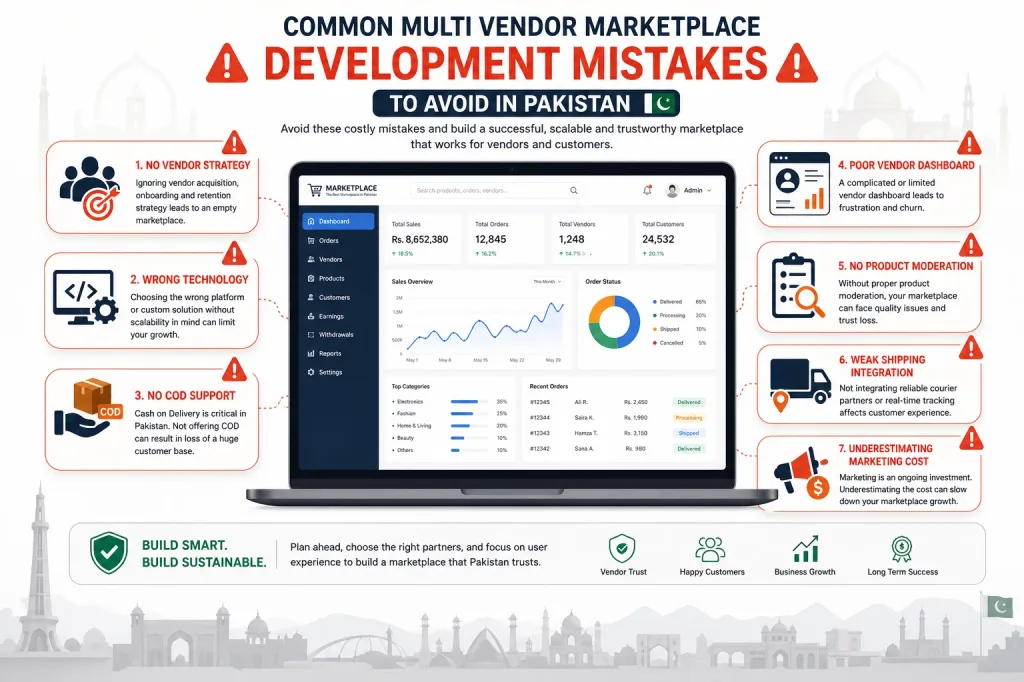
I’ve seen many marketplace projects fail in Pakistan. Here are the most common mistakes to avoid in your multi vendor marketplace development:
1. Building Everything Before Getting Vendors
Spending PKR 2,000,000 on a perfect marketplace before having a single vendor commitment. Start with an MVP, get 10-20 vendors onboard, then build advanced features based on real feedback.
2. Competing Directly with Daraz
Building a “better Daraz” is a losing strategy. Daraz has billions in funding. Find a niche they serve poorly and dominate it instead.
3. Ignoring the Vendor Experience
Most marketplace founders obsess over customer experience and neglect vendor tools. Without happy vendors, you have no products. Make vendor onboarding, product listing, and payout processes frictionless.
4. No COD Support
In Pakistan, 40%+ of online shoppers prefer Cash on Delivery. Launching without COD means rejecting nearly half your potential customers.
5. Wrong Technology Choice
Using a simple WooCommerce setup for an ambitious marketplace that plans to scale to 500+ vendors. Or conversely, spending PKR 2,500,000 on custom development for an unproven concept. Match technology to your stage.
6. No Vendor Acquisition Strategy
Building a marketplace and expecting vendors to come. You need a clear plan to onboard your first 50 vendors BEFORE launch—personal outreach, incentives, and competitive commission rates.
7. Underestimating Ongoing Costs
Development is only 30-40% of your total first-year cost. Budget for hosting (PKR 15,000-50,000/month), marketing (PKR 100,000-500,000/month), support staff, and maintenance.
Marketplace Development Process & Timeline
Professional multi vendor marketplace development in Pakistan follows this process:
Phase 1: Discovery & Planning (2-3 weeks)
Define your niche, vendor types, commission model, and feature requirements. Create user flows for vendors, customers, and admin. Identify key integrations (payment gateways, couriers).
Phase 2: UI/UX Design (3-4 weeks)
Design vendor dashboard, customer-facing marketplace, admin panel, and mobile experience. Create prototypes for key flows: vendor onboarding, product listing, checkout, order management.
Phase 3: Development (8-16 weeks)
Build the platform in sprints. Vendor management system first, then product catalog, then checkout/payment, then admin tools. Integrate JazzCash, EasyPaisa, COD, and courier services for Pakistani market.
Phase 4: Testing (2-3 weeks)
Test all user flows: vendor registration, product listing, purchasing, payment processing, order management, payouts. Load testing for performance. Security testing for payment flows.
Phase 5: Launch & Growth (Ongoing)
Soft launch with 10-20 vendors. Gather feedback. Fix issues. Then public launch with marketing push. The real work of a marketplace starts AFTER development—vendor acquisition and customer growth.
Professional Multi Vendor Marketplace Development Services
If you’re serious about building a marketplace in Pakistan, professional multi vendor marketplace development ensures your platform is built for scale from day one.
What I Offer
- Complete marketplace development — From concept to launch, including vendor system, customer marketplace, and admin panel
- Pakistan-specific integrations — JazzCash, EasyPaisa, COD, TCS/Leopards courier, FBR compliance
- Scalable architecture — Built to handle thousands of vendors and high traffic without performance issues
- Commission & payout system — Automated commission calculation and vendor payouts
- Mobile-responsive design — Optimized for Pakistan’s mobile-first market (70%+ mobile traffic)
- Post-launch support — 3 months of support, bug fixes, and assistance with vendor onboarding
Why Choose Professional Marketplace Development
- Marketplace experience — I’ve built multi-vendor platforms before and know the complexities that generic developers miss
- Pakistan market expertise — Understanding of local payment, shipping, and buyer behavior
- Scalable from day one — Architecture that won’t break when you grow from 10 to 500 vendors
- Fixed pricing — You get a detailed quote before work begins. No surprises.
Ready to Build Your Multi Vendor Marketplace?
Frequently Asked Questions
How much does it cost to build a marketplace like Daraz in Pakistan?
Building a marketplace like Daraz costs PKR 400,000 to PKR 2,500,000+ in Pakistan. A basic multi vendor marketplace (WooCommerce + Dokan) costs PKR 400,000-800,000. Professional custom marketplace costs PKR 800,000-1,500,000. Enterprise marketplace with mobile apps costs PKR 1,500,000-2,500,000+. The actual cost depends on features, technology choice, and scale requirements.
How long does multi vendor marketplace development take?
Multi vendor marketplace development takes 12-30 weeks depending on complexity. Basic MVP: 8-12 weeks. Professional marketplace: 14-20 weeks. Enterprise with mobile apps: 20-30+ weeks. This includes planning, design, development, testing, and launch support.
What features does a multi vendor marketplace need?
Essential features for multi vendor marketplace development in Pakistan: vendor registration/approval, vendor dashboards, product management, commission system, multi-vendor cart, unified checkout, JazzCash/EasyPaisa/COD payment, order management, reviews/ratings, admin dashboard, and courier integration (TCS, Leopards).
Should I use WooCommerce or custom development?
Use WooCommerce + Dokan for testing your marketplace idea (PKR 400,000-800,000, faster launch). Switch to custom development when you have 50+ active vendors and need scalability (PKR 800,000-2,500,000+). Many successful multi vendor marketplace startups begin with WooCommerce and migrate to custom once proven.
Can I build a niche marketplace instead of competing with Daraz?
Yes—niche marketplaces are actually more profitable! Profitable niches in Pakistan include: agricultural products, handmade goods, auto parts, B2B industrial supplies, services, wedding planning, and fashion designers. Niche multi vendor marketplace development costs less, launches faster, and faces less competition.
How do marketplace owners make money?
Revenue models include: commission per sale (5-25%, most common), vendor subscription fees, listing fees, advertising/promoted products, and premium vendor features. Most Pakistani marketplaces use 10-15% commission as primary revenue. With 100+ active vendors, expect PKR 200,000-1,000,000/month in commission revenue.
What technology is best for building a marketplace?
For Pakistani multi vendor marketplace development: WooCommerce + Dokan for MVP/budget (fastest, cheapest), Laravel + React/Vue for custom professional builds (scalable, full control), or SaaS platforms like Sharetribe for quick validation (fastest but limited). Cloud hosting on AWS or DigitalOcean recommended.
For more on marketplace platforms, check Dokan Multivendor Marketplace and Sharetribe Marketplace Platform.